
Field technique · Binocular setup
How to focus binoculars
Set binoculars for both eyes in five steps, adjust the dioptre correctly, fix common blurry-view mistakes and know when a fault needs service.
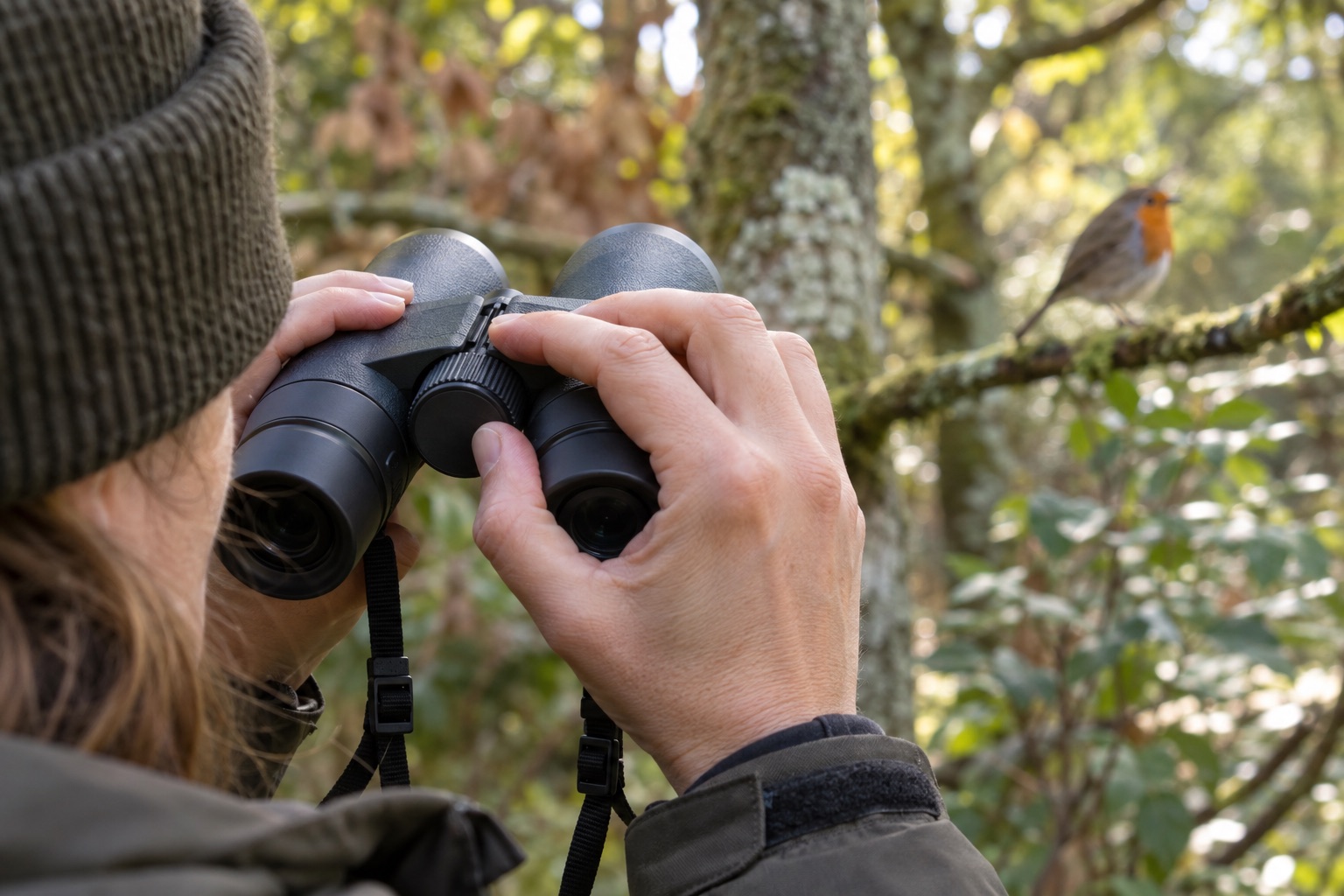
Cover one objective at a time; do not squeeze an eye shut.
Use the same distant, detailed subject for both eyes.
A dioptre is a personal setting, not a second focus wheel to turn for every bird.
Binoculars have two jobs that are easy to confuse. The central wheel changes focus for both barrels as the subject moves nearer or farther away. The dioptre corrects the difference between your eyes. Set the latter for you, then use the former in the field. Nikon's setup guidance follows this same sequence.
Five steps to a clear two-eye view
- Fit the eyecups. With glasses, start with them fully down; without glasses, extend them. If you see black crescents, change the cup position or your eye distance. This is an eye-relief issue, not necessarily focus.
- Set the hinge. Move the two barrels until you see one comfortable circular field rather than two overlapping circles. Do not force the hinge against its stop.
- Choose a fixed subject. A distant sign, textured wall or stationary branch in daylight is easier than a moving bird. Keep well away from the Sun.
- Focus the non-dioptre eye. On the usual right-dioptre binocular, cover the right objective with your hand and use the centre wheel until the left-eye view is crisp. Cover the objective rather than squeezing an eye closed, which can change your facial tension.
- Set the dioptre eye. Cover the left objective, keep the same subject in view and turn only the right dioptre ring until it is crisp. Uncover both and make a tiny centre-wheel adjustment if needed. If the dioptre locks, lock it now.
With both eyes open, move between a nearer tree and a distant roof using the central wheel only. You should not need to touch the dioptre again unless the binocular is shared. A model such as the Nikon PROSTAFF P7 has a locking dioptre, which may help if accidental movement is a recurring nuisance; it is not a reason to replace an otherwise good pair.
If the view still is not right
If one eye is clear and the other never reaches focus, check whether the dioptre has enough range for your prescription, that both caps are off, and that the ocular lens is clean. Try with your normal glasses if you wear them. If each barrel is sharp separately but the two-eye view is uncomfortable or visibly doubled, stop tweaking focus and read why binoculars show a double image. Alignment can be a service issue.
If focus is crisp centrally but fuzzy at the edge, you may be seeing normal edge aberration or placing your eyes off-centre. If the wheel grinds, catches or will not reach a distant subject, do not force it. Note the model and symptom for the maker or retailer.
For nearby flowers and feeders, check the binocular's minimum close-focus distance. No amount of turning will sharpen a subject closer than the instrument can focus. If the image suddenly looks milky after a damp outing, also check external versus internal fogging before adjusting anything else.
Helpful products
One model with a locking dioptre
A lock helps preserve your setting after shared use. It will not compensate for poor barrel alignment or the wrong eye spacing.

Nikon PROSTAFF P7 8x42
Best for: Wide viewing with glasses
A 590g all-round 8x42 with a wide 126m field, long stated eye relief and a locking dioptre ring that helps preserve a personal focus setting.
What stands out
- 126m field of view at 1,000m
- 20.2mm stated eye relief
- 590g waterproof body with locking dioptre
Keep in mind
- 3m close focus is useful rather than class-leading
- No ED glass in the published specification
- 8×42
- 590g
- 126m / 1,000m
- 20.2mm eye relief
Frequently asked questions
Focusing questions
Which eye do I focus first?
On most centre-focus binoculars, focus the left eye with the centre wheel while covering the right objective, then set the right-eye dioptre while covering the left. Follow your model's manual if its dioptre is elsewhere.
Should I reset the dioptre every time?
No. Reset it when another person has used the binocular, it has been knocked, or your prescription has changed. Use the centre wheel for normal near-to-far focusing.
Why is the edge blurry when the centre is sharp?
Some edge softness is an optical characteristic, not a focus error. Check that your eyes are centred and the eyecups give the right distance, then compare the central subject.
Can glasses wearers focus binoculars normally?
Yes. Usually lower the eyecups and use your glasses, then set the dioptre with them on. Confirm you can see the complete field comfortably.