
Zoom comparison · Spotting scopes
20–60× vs 25–75× spotting scopes
Understand what 20–60× and 25–75× really change in a spotting scope, and why field width, objective size and atmospheric conditions matter more than the top number.
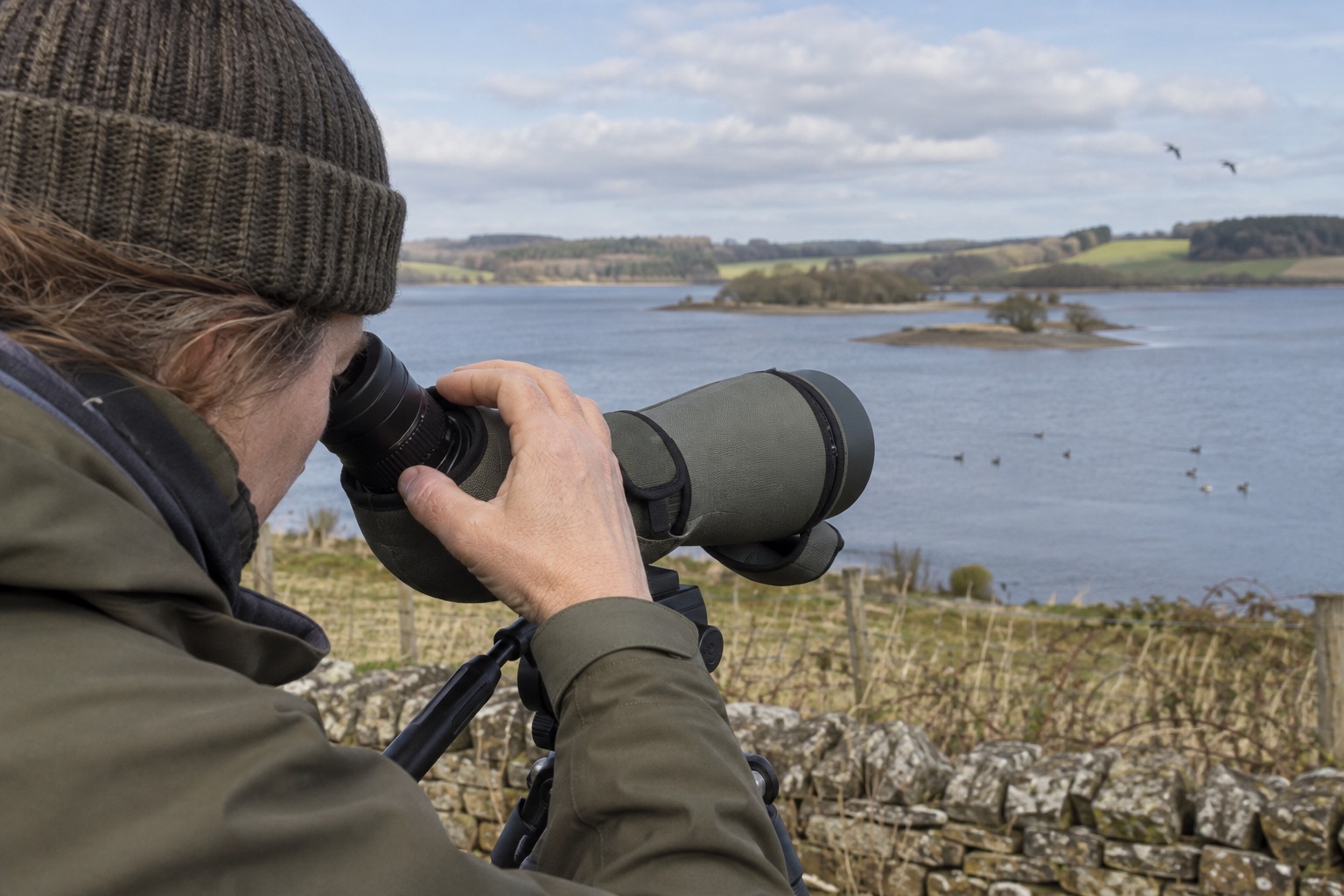
Find the subject at 20× or 25× before increasing power.
Compare field of view at the same distance, not only the zoom label.
Check which body and eyepiece produce the advertised range.
It is tempting to read 20–60× and 25–75× as a race in which 75× wins. For a birdwatcher, the starting power may matter more. At 20× you usually see a wider part of a mudflat and can centre a bird more quickly than at 25×. The extra power at the other end helps only when the image remains steady, bright and clear.
The labels do not describe equivalent instruments
Nikon's MC II zoom eyepiece specification is a useful reminder: one eyepiece gives different published ranges on different Fieldscope bodies, including 20–60× and 25–75× combinations. The higher range is not proof of a better optical design. Compare complete body-and-eyepiece systems, with the objective diameter, field width, eye relief and carry weight alongside the zoom.
A Celestron TrailSeeker 20–60×80 is a concrete 20–60× example, with a 35m field at 1,000m at 20×, narrowing to 17m at 60×. Another scope marked 25–75× may have a different objective size, eyepiece design or field specification, so a single row of zoom numbers cannot tell you which makes tracking birds easier.
What extra power costs
At higher power, every touch of the focus wheel and every small tripod movement becomes more visible. The true field narrows, making a moving bird easier to lose. The exit pupil also shrinks: divide objective diameter by power. An 80mm scope produces about 4mm at 20×, 1.33mm at 60× and 1.07mm at 75×. That final view needs careful eye placement and useful daylight. These are geometrical figures, not a promise of perceived brightness or image quality.
Air can be the harder limit. A distant wader above sun-warmed mud may look wavy or smeared even with excellent glass. The heat-haze explanation shows why a higher setting can reveal less practical detail. Equally, if the head jerks while panning, a smoother tripod head may improve your view more than another 15× on the dial.
A field test that answers the question
On a clear, distant subject, begin at the lower end of each scope. Compare how easily you find it and whether you can see the complete field with your glasses. Increase the zoom in small steps and note the last point at which a new feature becomes clearer—not merely larger. Repeat in duller light if that is when you actually birdwatch. A 20–60× setup with a broad low-end field may be more useful than a 25–75× one that spends its final quarter in shimmer. Conversely, an exceptionally well-supported larger instrument might make extra power worthwhile in calm, clear air.
For the underlying principle, read spotting-scope magnification explained. For a body-size choice, 65mm versus 80mm shows how aperture changes the usable range. Never aim a scope at or near the Sun.
Frequently asked questions
Zoom-range questions
Is 75× better than 60× for birdwatching?
Only when the optics, support, light and air remain good enough to reveal more detail. It often makes an already soft image larger without making it more informative.
Does 20–60× mean the eyepiece alone has 60× power?
No. The range describes the eyepiece in combination with a particular scope body. The same compatible eyepiece can produce different ranges on different bodies.
Why does the view darken as I zoom?
The exit pupil shrinks as magnification rises. On an 80mm objective it is 4mm at 20×, about 1.33mm at 60× and about 1.07mm at 75×.
Which range is easier for a beginner?
The lower starting power is generally easier for acquiring a bird, but the actual field width and eyepiece comfort still need comparing model by model.