
Troubleshooting · Repair decisions
When binoculars need professional repair
Decide which binocular problems need a retailer, manufacturer or qualified repairer, and which fit or cleaning issues you can safely fix yourself.
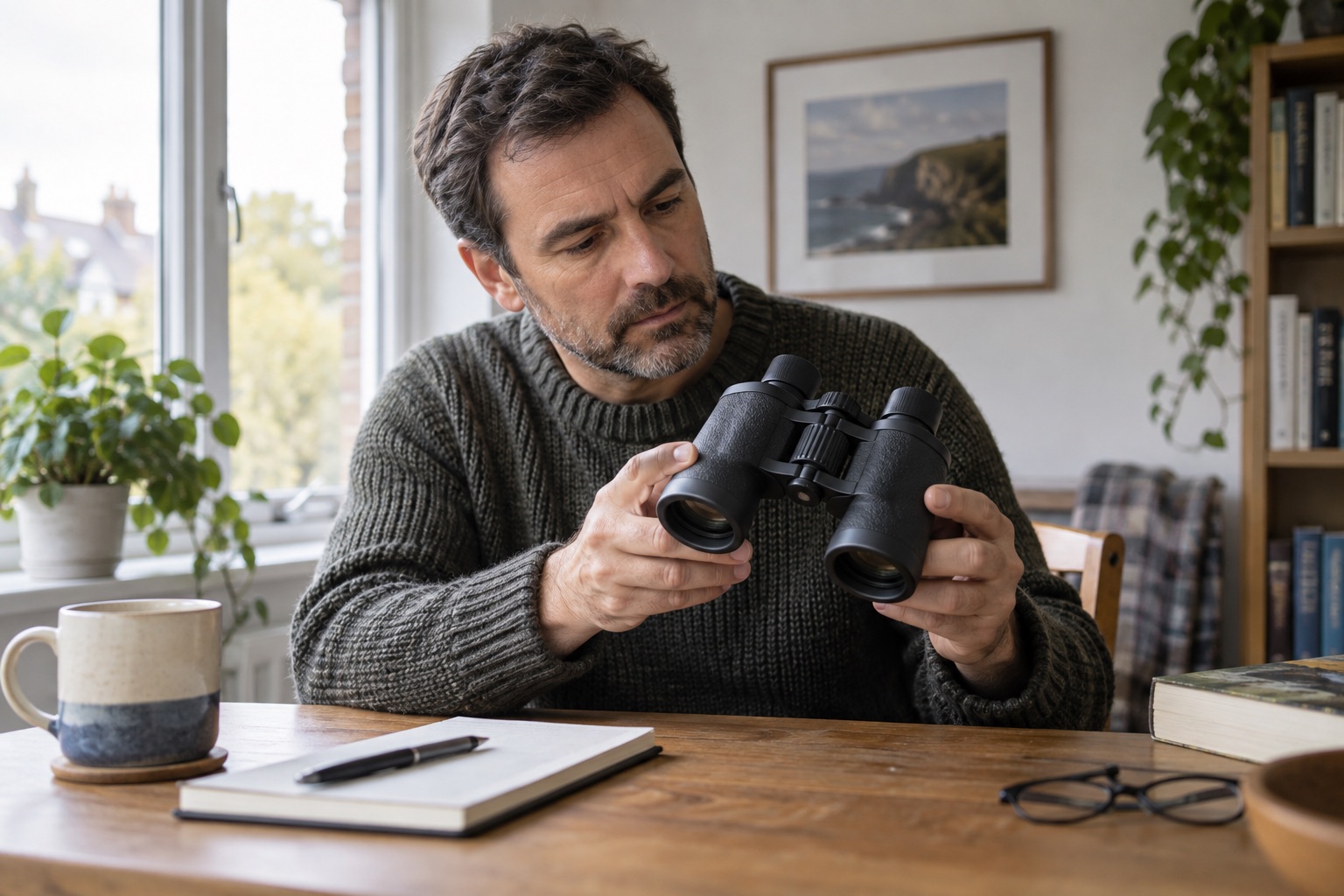
Record the model, symptom and circumstances before contacting service.
Check a warranty or retailer route before paying for work.
Ask whether a repair includes alignment and resealing checks.
Some disappointing binocular views are fit problems. Others are faults inside a sealed, precisely aligned instrument. Knowing where that boundary lies can save an unnecessary repair bill—and prevent a home fix from making a repair impossible.
Start with checks you can undo
Set the hinge so the two circular fields merge, then try the right eyecup position for your eyes or glasses. Follow the focusing and dioptre sequence on a stationary daylight subject. If the image is obscured, check for removable dirt or exterior condensation before assuming an internal defect. Each of these checks leaves the binocular intact.
If a specific part such as an eyecup or lens cap is missing, ask about a maker-approved replacement. Do not improvise an adhesive near a lens or moving control. A soft case, clean cloth and patience solve many ordinary ownership problems without repair work.
Faults that justify an expert opinion
- Persistent double image: both barrels are individually sharp, yet the combined scene is displaced after correct eye spacing and dioptre setup. Read the double-image checks and stop if the problem remains.
- Internal moisture or contamination: a film stays behind clean external glass, returns after rain or develops a web-like mark. Internal fog and possible fungus need diagnosis, not an exterior cloth.
- Mechanical trouble: a focus wheel grinds, jams or spins without moving focus; the hinge is loose after impact; or one eyecup no longer stays in position.
- Impact or immersion: a fall, knock or water exposure precedes a change in focus, field alignment or sealing. Continue only with safe exterior drying and documentation.
An occasional soft edge or an image that will not focus on a flower closer than the model's stated limit is not proof of failure. Compare the central view against the published close-focus distance first.
What to ask before sending a pair away
Give the seller or maker the exact model, serial number if present, proof of purchase, clear description of the fault and any relevant weather or impact history. Ask whether warranty applies, what a diagnosis costs, whether the estimate is approved before work and what happens if parts are unavailable. For a waterproof model, ask whether the service includes an alignment and seal check afterwards.
Do not loosen prism screws, open a barrel, spray lubricant into the focus assembly or apply strong heat to remove moisture. These actions can make the original fault harder to identify. Nikon's binocular precautions warn against impact, extreme heat and forcing controls. Celestron's optics service advice notes that internal cleaning and fungus require a different level of work from ordinary exterior care.
Frequently asked questions
Repair questions
Are binoculars worth repairing?
That depends on model value, warranty, fault and the quoted service cost. A durable mid-range or premium pair may justify assessment; an older entry pair may not. Get a diagnosis before deciding.
Can a double image be repaired?
Sometimes. A qualified service provider can assess alignment, but the cause and cost vary. Avoid turning prism screws based on an online shortcut.
Should I open a binocular to dry it?
No. Opening a sealed body can disturb optical alignment and weather protection. Keep the exterior dry and contact the maker or repair service.
Do I contact the shop or manufacturer first?
For a recent purchase, start with the seller and have proof of purchase ready. For an older or out-of-warranty pair, check the maker's service route and obtain a written estimate.